GEO means getting your pages cited in AI answers from Google, ChatGPT, Perplexity and Copilot. What it is, what the evidence says, what is hype, and how to measure it.
SEO & AI Search

Last updated: October 2026.
Generative engine optimization (GEO) is the practice of making your pages more likely to be used and cited when an AI tool writes an answer, in Google’s AI Overviews and AI Mode, ChatGPT search, Perplexity or Microsoft Copilot. The honest summary: most of what works is ordinary good SEO, the published evidence is thinner than the sales pitches suggest, and you can now measure part of it for free in Search Console and GA4.
You have probably met the term the same way most people do. A colleague forwards a LinkedIn post saying “SEO is dead, you need GEO”, an agency quotes for an “AI visibility audit”, and someone asks whether the website needs an llms.txt file by Friday. This guide explains what GEO actually means, how these AI answers pick their sources, what the search companies themselves have said, and which tactics are hype.
Short answer: GEO (also called AEO, answer engine optimisation) means shaping your content so AI search tools can find it, understand it and cite it. Google says there are “no additional requirements” to appear in AI Overviews or AI Mode beyond normal Search eligibility. In practice that means: let the crawlers in, answer questions clearly near the top of the page, publish things others cannot (original data, first-hand experience), and earn mentions on other sites. Ignore anyone promising guaranteed AI citations.
The term generative engine optimization comes from a research paper, “GEO: Generative Engine Optimization” by Pranjal Aggarwal and colleagues, published on arXiv in November 2023 and accepted at the KDD 2024 conference. The authors used “generative engine” for any search tool that writes an answer from web sources instead of just listing links, and GEO for the work of getting your content into those answers.
AEO, answer engine optimisation, is older and looser. SEO people used it for featured snippets and voice assistants, and it has been recycled for AI answers. Today the two terms mean roughly the same thing, and you will also see “LLM SEO”, “AI SEO” and “AI search optimisation”. Don’t let the alphabet soup worry you: they all describe the same goal.
The key difference from classic SEO is the prize. In classic search you want a high position in a list of links. In AI search the tool reads several pages, writes its own summary and shows a handful of sources. Being one of those sources, and being described accurately, is the win.
The details differ by product and none of the companies publishes its ranking formula. But the official documentation describes a similar pattern.
How it works
How an AI answer picks its sources
Simplified from Google’s and OpenAI’s own documentation
Sources: Google Search Central “AI features and your website”; OpenAI Help Center “Searching the web with ChatGPT”.
Google’s page AI features and your website is the most useful primary source on GEO anywhere. It says both features may use “query fan-out”, running several related searches across subtopics, and then pick supporting pages while the answer is generated, so they can show a wider range of links than classic results. The sources come from Google’s normal index. To be eligible, a page must be indexed and able to show a snippet. Google is blunt that there are no extra technical requirements and no “special optimizations necessary”.
Google also gives site owners an off switch. Since 31 August 2026 every Search Console property has a Search generative AI control (Settings, then Search generative AI) that can exclude your links and content from AI Overviews, AI Mode and AI features in Discover without removing you from normal results. Google says the setting is not used as a ranking signal elsewhere in Search.
OpenAI’s help article Searching the web with ChatGPT says ChatGPT rewrites your question into one or more targeted queries and sometimes sends them to partner search providers (its privacy note points to Microsoft, so Bing is one of them). It says results are ranked on “multiple factors” and placement is not guaranteed. The one concrete instruction: allow OpenAI’s search crawler, OAI-SearchBot, and make sure your host or CDN does not block OpenAI’s published IP addresses.
OpenAI’s crawler documentation separates its bots. OAI-SearchBot decides whether you can appear in ChatGPT search answers. GPTBot collects content that may be used to train OpenAI’s models. ChatGPT-User fetches a page when a person asks ChatGPT to, and OpenAI says robots.txt rules may not apply to it. The settings are independent, so you can block training (GPTBot) and still allow search (OAI-SearchBot). Our guide to blocking AI crawlers with robots.txt covers the exact lines.
Perplexity’s crawler page lists PerplexityBot, which surfaces and links sites in its answers and which Perplexity says is not used to train AI models, and Perplexity-User, which fetches pages on a user’s request and “generally ignores robots.txt rules”. Perplexity has not published how it ranks or chooses sources. The many “how Perplexity picks sources” articles you will find are third-party guesswork. If you are weighing it against other tools, see our Perplexity alternatives guide.
Copilot is grounded in Bing. In February 2026 Microsoft launched an AI Performance report in Bing Webmaster Tools, in public preview. It shows how often your pages are cited in Copilot, Bing’s AI summaries and some partner integrations. Microsoft’s own advice in that post is plain: clear headings, tables and FAQ sections, claims backed by evidence, and IndexNow to tell Bing when pages change.
Most of GEO is SEO with a different scoreboard. Each AI tool searches an index first, so a page that cannot be crawled, indexed or understood has no chance of being cited. What changes is what counts as winning and how you measure it.
Side by side
Classic SEO vs GEO
Different scoreboard, mostly the same groundwork
Two differences matter in practice. First, AI tools work with passages, not whole pages. A paragraph that answers one question on its own is easier to lift and cite than an answer spread across a long introduction. Second, clicks are scarcer. When Pew Research Center tracked the browsing of 900 US adults in March 2025, people clicked a traditional result on 8% of visits to Google results pages with an AI summary, against 15% without one. They clicked a link inside the summary on just 1% of visits.
By the numbers: in Pew’s March 2025 data, 18% of the 68,879 Google searches studied produced an AI summary, and users ended their browsing session after 26% of those visits, compared with 16% when there was no summary. Being cited is visibility; it is not the same as being visited.
Google argues the other side. Its May 2025 Search Central post on succeeding in AI search says clicks from results pages with AI Overviews are “higher quality”, meaning visitors tend to stay longer, and suggests judging visits by conversions rather than raw clicks. Google has not published the data behind that, so treat it as a claim.
There is far more GEO marketing than GEO evidence. Here is what we could trace to a primary source.
What we did not find: any primary source for the widely shared claims that a specific word count, a particular heading style, or a “freshness” date stamp gets you cited. If a stat in a GEO pitch has no link to who measured it and how, leave it out of your decisions.
Common mistake: blocking every AI bot in robots.txt to “protect” content, then wondering why ChatGPT never cites you. Blocking GPTBot stops training; blocking OAI-SearchBot removes you from ChatGPT search answers. They are separate decisions. Check our robots.txt guide before copying a blanket block list.
llms.txt is a proposal by Jeremy Howard, first published in September 2024: a Markdown file at /llms.txt that gives AI tools a short summary of your site and links to clean versions of key pages. It is a sensible idea for developer documentation that coding assistants read. But no major AI search engine has said it uses llms.txt to choose or rank sources. Google’s documentation goes further and says you don’t need to create “new machine readable files, AI text files, or markup” to appear in AI Overviews or AI Mode. Adding one is harmless; paying someone to build one as a GEO strategy is not money well spent.
AI answers change with the wording of the question, the user’s location, earlier messages in the chat and model updates. Nobody can guarantee you will be cited, and “rank #1 in ChatGPT” is not a stable position that exists. AI visibility trackers can be useful for spotting trends across a fixed set of prompts, but treat their scores as samples, not truth. Our SEO tools cost guide compares what those trackers charge.
Every AI search tool documented above starts from a search index. If anything, AI search makes technical SEO basics more important, because a page that is blocked, slow to render or buried in scripts is invisible to both.
Clicks and impressions from AI Overviews and AI Mode are counted in the normal Performance report under the “Web” search type. Google’s help page says an AI Overview occupies a single position and every link in it gets that position, while AI Mode positions follow the usual rules. Since 31 August 2026 there is also a separate Generative AI performance report, rolled out to all sites, showing impressions in AI Overviews and AI Mode by page, country, device and date. It does not show clicks, so you cannot yet calculate an AI click-through rate in Search Console. If you are new to the tool, start with our Google Search Console guide.
GA4 now has an AI Assistant channel in its default channel group. Google describes it as visits from sources such as ChatGPT, Gemini, DeepSeek, Copilot or Grok, with the medium set to “ai-assistant”. Google says it excludes AI Overviews and AI Mode, which stay under Organic Search. To see it, go to Reports > Acquisition > Traffic acquisition and look at the Session primary channel group.
For more detail, switch the dimension to Session source / medium and look for referrers such as chatgpt.com, perplexity.ai, copilot.microsoft.com and gemini.google.com. Google does not publish the full list of sources the AI Assistant channel recognises, so check for any AI referrers still showing as plain “referral”. Many links clicked in ChatGPT also arrive tagged with utm_source=chatgpt.com, which makes them easy to spot in landing-page reports.
Be realistic about the numbers. Some AI visits arrive without a referrer (copied links, some in-app browsers) and land in Direct. For most sites, AI referrals are still small next to Google organic. Watch the trend and what those visitors do, not the absolute number.
The AI Performance report shows citations in Copilot and Bing’s AI summaries, plus sample “grounding queries” (the phrases the AI used to find your content). Like Google’s new report, it shows visibility, not clicks.
We read the primary documentation on 18 October 2026: Google Search Central and the Search Console and Analytics help centres, OpenAI’s crawler page and help centre, Perplexity’s crawler page, Microsoft’s Bing Webmaster blog, the llmstxt.org proposal, the GEO paper on arXiv, Pew Research Center’s report and Ahrefs’ study. Where a commonly repeated figure could not be traced to who measured it, we left it out. This is an explainer; we did not run our own citation experiment for this piece.
Partly. The goal differs (being cited in an AI answer rather than ranking in a list), but the groundwork is the same: crawlable, indexed, clearly written and genuinely useful pages. Google says there are no additional requirements for AI Overviews or AI Mode beyond normal Search eligibility.
No. Google says you don’t need new machine-readable or “AI text” files for its AI features, and no major AI search engine has said it uses llms.txt for ranking or citations. It can help AI coding tools read developer documentation, and it does no harm, but it is not a GEO strategy.
In GA4, check the AI Assistant channel under Reports > Acquisition > Traffic acquisition, or look for chatgpt.com in Session source / medium. To be eligible for ChatGPT search at all, make sure OAI-SearchBot is allowed in robots.txt and not blocked by your host or CDN.
Yes. In Search Console, Settings > Search generative AI lets you exclude your site from AI Overviews, AI Mode and Discover’s AI features while staying in normal results. Snippet controls such as nosnippet also limit what is shown. Google-Extended limits AI training but does not remove you from AI Overviews.
It helps Google understand your pages and qualify for rich results, and Google lists it among good practices. But Google says no special schema is needed for AI features, so treat it as part of good SEO, not a shortcut to citations.
Only if they explain their method, measure against a fixed set of prompts over time and make no guarantees. If the pitch leads with llms.txt, secret ranking factors or untraceable statistics, walk away. Fixing crawl access and writing clearer pages usually comes first.
Keep going: check your crawl settings with our guide to blocking AI crawlers with robots.txt, learn the reports in our Google Search Console guide, and compare what SEO and AI visibility tools cost in SEO tools: what they really cost. For a realistic look at AI tools themselves, read ChatGPT for data analysis: what it can and can’t do and our Perplexity alternatives.
Keep reading
 SEO & AI SearchYoast vs Rank Math in 2026: Free Features, Real Renewal Prices and a Clear Verdict4 min read
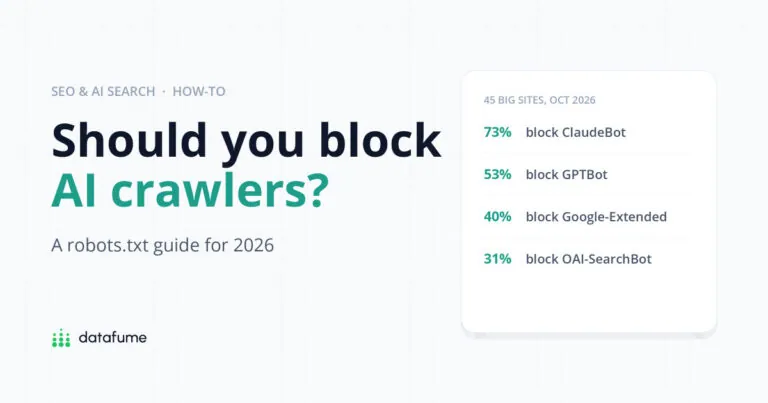 SEO & AI SearchShould You Block AI Crawlers? A robots.txt Guide for GPTBot, ClaudeBot and More (2026)12 min read
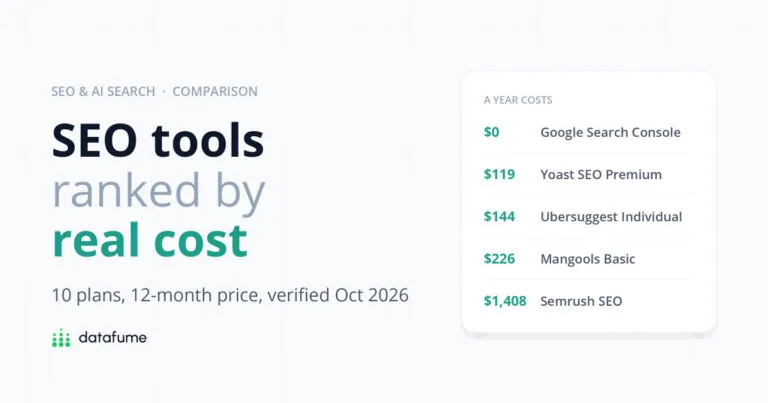 SEO & AI SearchSEO Tools Cost Compared (2026): 10 Plans Ranked by Real 12-Month Price12 min read
Short, free guides that take you from zero to your first real analysis. No sign-up needed.

Join our newsletter for new data guides, tool reviews and free resources.
By subscribing you agree to our Privacy Policy and consent to receive emails from DataFume.
© 2026 DataFume. All rights reserved.